
16 October 2024
#RightToRehab
We need urgent action for the thousands missing out on the support they need to manage their health or recovery. We’ve joined the #RightToRehab campaign asking the Government to invest in prevention and rehabilitation.
Will you help by emailing your MP? Click here for your template.
#TheSST #RightToRehab
Continue reading 
11 October 2024
Bridget Daly and Zara Tangi heading for World Transplant Games, Dresden
The SST World Transplant Games Travelling Scholarship Award in Association with Transplant Sport UK has gone to SST Member Bridget Higgs and Student Member Zara Tangi.
Both will travel to Dresden, Germany in August 2025 as part of the Transplant Sport Therapy Team. They will also link up with the Therapy Team for the British Transplant Games in July, in Oxford.
This was only the second year to combine the sponsorship with a travel opportunity for SST Members but the first to offer an award to both a Graduate and Student Member.
Sports Therapy Masters Graduate Bridget works at Physical Balance a multidisciplinary Clinic in Basingstoke. She works with athletes and has also specialised in paediatric injuries, returning children back to sport.
Student Zara has just progressed into her second year on a Sport and Exercise Therapy degree programme at Solent University. Zara has wanted to be a Sports Therapist and work in sport from an early age. Her passion for anatomy and dealing with injuries will no doubt take her far.
Alison Bloxham Therapy Lead for Transplant Sport together with SST Director Thomas Hames, conducted the interviews. Alison said:
‘I was extremely impressed by the overall standard. Both Bridget Higgs and Zara Tangi were outstanding in their interviews, and we are all excited by the prospect of them joining the Therapy Team in both Dresden and at the British Transplant Games.’
SST CEO Simon Bowen visited this year’s Transplant Games in Nottingham; a trip that convinced him that this sponsorship was important for both Transplant Sport and The SST. He said:
‘The transplantees taking part in the Games were incredible, as was the therapy team who are so dedicated yet receive no funding support. This partnership introduces our members not just to learning opportunities through travel but also to meeting and working with transplantees, opening another pathway to use their skills. Huge congratulations to Bridget and Zara; enjoy the experience.’
Transplant Sport and Organ Donation
The SST recognises the value of taking part in sport for people who have had successful, life-saving transplants, to keep fit and healthy and in providing a space to meet other transplant recipients, transplant donors and their supporters. We also appreciate the great need to increase transplant awareness and organ donation. Transplant Sport is the largest national charity promoting active recovery for transplant recipients and increasing awareness of the benefits of organ donation – have you told your family or friends that you wish to donate?
For more information visit Transplant Sport and Home – NHS Organ Donation
Bridget Daly
Zara Tangi
Continue reading 
10 October 2024
SST Board votes in new Chair and Vice Chair
The Board of Directors and Chief Executive Officer (CEO) of The Society of Sports Therapists (The SST) are pleased to announce that Dr Christopher Holland and Keith Waldon have been elected as their new Chair and Vice Chair.
Christopher is Head of Department for Sport Management, Therapy and Exercise at the University of Worcester and previously held the role of Vice Chair of The SST.
Stepping up to take over the position of Chair, Christopher said:
“I am truly delighted to be elected as Chair. I am passionate about serving our Society and its members, and I look forward to working to achieve our shared goals and aspirations. I hope to continue the work that has seen our Society become a more forward-thinking organisation, embracing innovation and progress for the benefit of all our members.”
Christopher has already played a key role in major developments for The SST, including the appointments of CEO Simon Bowen and Head of Education Kate Williams, and in spearheading the new Research and Scholarship Task Team, on which he now leads. He himself has an active research portfolio that is internationally recognised.
In supporting Christopher and the Board of Directors, Keith, the CEO of Up and Running Sports Injury Clinics in Portsmouth, will be able to call on his wealth of knowledge and experience with The SST. Keith was a major driving force in setting up the Universities and Colleges degree programme and he has mentored and employed many SST Graduate Members. Keith is a member of the Industry Recognition Task Team and his passion for The SST and Statutory Regulation for Sports Therapists in particular, remains as strong as ever. He said:
“I am honoured and delighted to have been voted as Vice Chair by the Board of Directors. It is a position which gives me opportunities to use my contacts and knowledge of all things Sports Therapy. I look forward to serving The SST and our Members, to enhance the standing and opportunities for advancement of our profession”.
After a year of transition, both Christopher and Keith recognise that there is much work to be done and they are both ambitious to work more closely with our Members, students, education partners and stakeholders. Now with a CEO and Head of Education in place to support the Board, together with the newly founded Task Teams and our experienced Head Office Staff, the future is looking bright.
Dr Christopher Holland Keith Waldon
Continue reading 
16 September 2024
Our Response to the Darzi Report
Lord Darzi’s emphasis on patient-centered care, improved access to services, and integration of health professionals resonates strongly with our own values and mission.
We are particularly encouraged by the report’s focus on interdisciplinary collaboration, which highlights the vital role that all healthcare professionals, including sports therapists, play in promoting injury prevention, rehabilitation, and overall physical well-being. In many respects, the report strengthens the need for statutory regulation of GRADUATE SPORTS THERAPISTS and we are working to achieve this with the new Government.
We look forward to working in alignment with the recommendations put forward in this report to continue contributing to a healthier, more active society. Together, we can build a future where access to high-quality healthcare services, including sports therapy, is expanded and the health and wellness of all individuals are prioritised.
Continue reading 22 August 2024
SST charity partner announced plus travelling scholarship news
The Society of Sports Therapists (The SST) is proud to announce Transplant Sport as its official partner charity for 2024/2025, together with exciting news of a World Transplant Games Travelling Scholarship.
The focus of the sponsorship will continue to be the Transplant Sport Therapy Team. Led by SST Honorary Members Alison Bloxham and Sheila Leddington Wright, they have opened the door to both SST Graduate Sports Therapists and students and a world of very special experience working with transplantees.
In 2023, Patrick Gaffey was the winner of The SST, Transplant Sport Travelling Scholarship to the World Transplant Games in Australia and what an amazing time he had. 2025 sees the Games closer to home in Dresden Germany, setting the stage for a double opportunity for both a Member and Student, not only to make the overseas trip, but also to participate in the 2025 British Transplant Games.
SST CEO Simon Bowen who recently attended the British Transplant Games in Nottingham said:
‘This was my first experience of the British Transplant Games and I was in awe of the transplantees and the tireless work of the therapy team. I am delighted that The SST is able to continue this support and that for the first time, we are able to offer this opportunity to both a Graduate and Student Member.’
(The application process for The SST, Transplant Sport Travelling Scholarship is now closed).
Continue reading 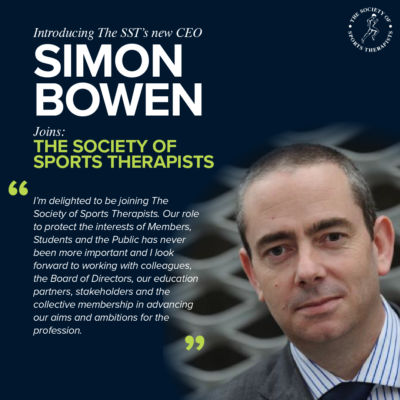
9 July 2024
Simon Bowen is the new CEO of The Society of Sports Therapists
The Society of Sports Therapists (The SST) is delighted to announce the appointment of Simon Bowen as the new Chief Executive.
Simon brings with him a wealth of experience and commercial acumen gained from senior leadership roles held across various high profile professional bodies. These included the Royal College of General Practitioners, the British Psychological Society and the Institution of Occupational Safety and Health. His most recent role before joining The SST was as Director of Membership at the Chartered College of Teaching.
Simon’s work within the charitable bodies sector has consistently focused on the development and implementation of membership engagement strategies, global expansion and partnerships.
For SST Chair Michael Cole, the appointment comes at a time of significant strategic development for the organisation and both he and the Board of Directors will be looking to Simon to play a pivotal role. He said:
“During selection, the Board was especially impressed by Simon’s professional courage and leadership acumen; Simon shares the Board’s collective passion for our membership, and for greater professional recognition, and we are certain he will work well with the Board to ensure The SST not only remains the leading professional body but advances us further in alignment with our Vision, Mission and Values. As such, the Board is incredibly excited to see The SST develop under Simon’s operational leadership, with his experience, skills and enthusiasm driving us forward to continue the modernisation that, as Chair, I have been so proactive and committed in foregrounding.”
Simon is a Fellow of the Chartered Management Institute (CMI) and the Institute of Leadership and Management (ILM). He also has a postgraduate Diploma in Management and an MBA from Warwick Business School. He said:
“I’m delighted to be joining The Society of Sports Therapists. Our role to protect the interests of Members, Students and the Public has never been more important and I look forward to working with colleagues, the Board of Directors, our education partners and the collective membership in advancing our aims and ambitions for the profession.”
Continue reading 
23 April 2024
Chair of SST Begins New Role at Imperial College London
The Society of Sports Therapists (SST) is delighted to announce that our Chair, Michael Cole, has been appointed to the role of Principal Teaching Fellow in Equality, Diversity, and Inclusion (EDI) at Imperial College London, a university ranked 6th globally in the QS World Rankings.
As well as enhancing the work already being done at Imperial, through his knowledge and passion for EDI in higher education and healthcare, Michael’s position provides a platform towards generating greater recognition and understanding of Sports and Exercise Therapy across the health and medicine landscape in the UK.
We caught up with Michael to talk to him about his new role and what it means to both himself and the SST.
Q: What are you most excited about in your new role?
A: Firstly, I am delighted to be a Principal Teaching Fellow in Equality, Diversity and Inclusion [EDI] at Imperial College, a University with great staff and students. I am especially excited to use my knowledge and passion for EDI in higher education and healthcare to build upon the great work already being done at Imperial and to be leading and collaborating on enhancements and developments that benefit the staff, and the medical students and the communities they serve.
Q: How did you come to embark on a role in EDI in a medical school?
A: It’s an interesting and varied journey, and I hope the variety of experiences enhance my impact at Imperial. Having had 20 years working across both clinical MSK therapy (in elite sport, private practice, and TV/film) and education (as a BSc Sports Therapy Course Leader, and Quality Assurer), in 2011 I also began research into healthcare-pedagogy inequalities during postgraduate study at Loughborough University. By 2018 this had evolved into PhD research, and I had begun various consultancies with colleagues and universities on Higher Education projects aimed at developing inclusivity and reducing and eradicating inequality gaps. Supporting the professional development of educators and practitioners across the medicine and healthcare sectors, including Graduate Sports Therapists and trainee doctors, is now not only my passion, but also – I am proud to say – my day job (though I do still enjoy being clinically active one day per week!).
Q: How will this appointment impact the SST?
A: I am certain that my position at Imperial is mutually beneficial to the SST, with the experiences gained and networks developed helpful to both my role as Director and Chair, and another positive nudge towards the greater recognition and understanding of Sports and Exercise Therapy across the health and medicine landscape in the UK and globally. As a recent example, just the other day it was great to represent the SST by attending Parliament for the April launch of ARMA’s ‘Act Now: Musculoskeletal Health Inequalities and Deprivation’ report, and the very next day I was able to share the report’s findings and recommendations with both Imperial College London as well as with the SST’s new Head of Education for dissemination to our accredited universities.
Q: Tell us about the department you will be working in?
A: The role of Principal Teaching Fellow in EDI is actually a brand new one, and the first of its kind in the Undergraduate Primary Care Unit [UPCE] at Imperial College.
Imperial’s UPCE is one of the UK’s largest teams of its kind, with an exemplary international reputation for curricular innovation in the Department of Primary Care and Public Health, within the School of Public Health (SPH) in the Faculty of Medicine at Imperial College London.
Academic General Practice is a major contributor to teaching within the Faculty of Medicine, and the UPCE works with over 500 GPs to deliver teaching across multiple clinical placements.
Q: Why is Academic General Practice so important?
A: General Practice is a diverse, flexible, innovative and continually evolving environment that rapidly adapts to technological advances, new challenges and fresh opportunities.
Undergraduate GP teaching must constantly develop and adapt to keep in step with such changes and to ensure the continued availability and validity of training experience that is equitable and inclusive, taking account of diverse student bodies, staff and patient populations.
Q: What do you hope to achieve in your new role?
A: I am working closely with the Imperial College School of Medicine (ICSM) to lead development and implementation of best practice Equality, Diversity and Inclusion (EDI) principles across the undergraduate primary care curriculum and contribute to development and implementation of ICSM strategy relating to EDI. Again, the professional cross-pollination of knowledge-exchange via interdisciplinary practice is something I am passionate about and have engaged in for many years, which fits nicely with the General Medical Council’s (GMC) Professional Capabilities Framework (Domain 8) which states that ‘doctors in training must demonstrate that they can promote and participate in interprofessional learning’. As such my experience and roles within EDI across musculoskeletal sports and exercise medicine enhances my role; for example, earlier this year I represented the SST at The Future of Musculoskeletal (MSK) Care event, organised by NHS England and The Joint DHSC DWP Work & Health Directorate. Contributing to and listening to discussions on Innovation and Emergent Practice in MSK care ensured I could bring the SST’s presence and innovations to industry whilst also learning and networking, and taking this all back to share with both the SST’s Board and CEO, and colleagues at Imperial College.
Conclusion:
Michael’s appointment as Principal Teaching Fellow in Equality, Diversity, and Inclusion at Imperial College London represents a significant achievement for our society, helping to elevate our visibility, enhance collaboration opportunities, and empowers us to actively shape education and practice in MSK therapy with a focus on inclusivity and equity.
This affiliation strengthens our commitment to promoting excellence and diversity within the profession.
The SST looks forward to seeing more of the important work Michael is carrying out with colleagues at Imperial College, and we wish him all the best!
Continue reading 
28 February 2024
Message from SST Director Jenie Owens
As the newest director on the Board, it is a pleasure to have the opportunity to open this newsletter, to update you on some of the activities that The SST has undertaken, and tell you about some of the opportunities coming up where YOU can get involved.
A new marketing agency has been appointed to take The SST’s communications strategy to the next level and, alongside this, work is in its final stages of development for a new website. This will not only help improve engagement for Members but also do much to help modernise processes for our office staff.
The SST was recently in attendance at the ‘Designing the Future of MSK Care’ event organised by the Horizons NHS Commissioning Support Unit. The SST engaged productively with national industry and organisation leads and representatives, discussing and advising on how Graduate Sports Therapists are part of the solution for MSK care in the UK, and how greater integration, collaboration and partnerships are the way forward. Watch this space for updates on developments and outcomes.
In previous correspondence we mentioned getting involved with our Task Teams. This is a great way to be at the forefront of SST developments, to keep up to date with what The SST is currently working on behind the scenes and a real opportunity to express your opinions and contribute to the further development of The SST.
My passion lies in elevating the discipline of Sports Therapy and I have made it my mission to help achieve Statutory Regulation for Sports Therapists. If this is your passion, why not reach out and see how you can become a part of our Industry Recognition Task Team?
Finally, make sure to keep an eye on your inbox, as I will be sending out next month a Directors’ Update, with more detail on the different Task Teams, what each is looking to achieve and how you can get involved.
Best wishes
Jenie Owens
Continue reading 
27 February 2024
Top Awards for SST Members Adam Gaunt and Jenie Owens
SST Director Jenie Owens and University and College Liaison Task Team Vice Chair, Adam Gaunt, have both received top awards from community healthcare services provider Connect Health, at a glittering event, held recently at the Hilton Bankside, London.
Adam took the national award for ‘Leader of the Year,’ and similarly Jenie took the top accolade in the category, ‘Living Our Values – People Centred.’
The annual awards recognise a host of different qualities as well as employee skills and performance, and the whole workforce is given the opportunity to vote.
Jenie, a Graduate from the University of Hertfordshire, joined Connect Health in 2022 and has swiftly risen through the ranks becoming a Team Leader in 2023. While her team is spread out geographically, Jenie has been creative in bringing them closer together. She was recognised for her team building skills, not only through encouraging learning across sites but also putting a smile on colleagues’ faces through marking celebrations, organising events and creating fun projects and competitions.
Adam is passionate about rehabilitation and he is clearly bringing some of the skills and knowledge he used in his former role at Hartpury University to the NHS. Working in Witney, Oxfordshire, he has been recognised for the empathy he has with his colleagues, his professionalism and approachability, creating a culture of fun and space for self-expression, while maintaining respect and high standards. He was praised for his caring approach towards wellbeing as well as performance; a great mentor and true team player.
Adam has worked hard to give patients gym access for their rehabilitation; something that fits readily into the Government’s newly named, MSK Physical Activity Hubs. He understands that rehab takes time and one size does not fit all. Adam challenges his colleagues to find the optimal plan for each individual patient, encouraging therapists to move away from the model if it doesn’t fit the patient.
Connect Health has been a driving force in recognising the talents of The SST’s Graduate Sports Therapists. It was an early identifier of skills and abilities as opposed to titles and has brought together several professions under the MSK Clinician banner. The Connect Health management team has also been instrumental in developing career pathways for Graduate Sports Therapists.
Jenie and Adam are passionate about Sports Therapy and are both championing the setting up of SST student placements. While in its early stages, the project offers great opportunities for students, wishing to work in an NHS clinical setting, to get a foot on the Sports Therapy career ladder.
So, what of the future for these aspiring young therapists?
Jenie said:
‘I love the clinical side providing patient care but realise that I cannot do this forever. I also suffer from time to time with fatigue as I have auto immune issues. Longer term, I will look at a possible managerial role in operations or with our Service Team.’
Adam, who also runs his own private clinic, Adam Gaunt Sports Therapy, is keen to progress his career with Connect Health but in a different direction to Jenie. He said:
‘Our Tier 1 has a clinical focus and rather than progressing to Tier 2, which is more triage, referral and complex cases, Tier 1 is more rehabilitation and working with the patients to manage their conditions.
‘I would like to try and influence policy at Tier One by developing the rehabilitation role and pushing the boundaries– creating projects around rehab, with more goal setting, objective measures, benchmarking and quality testing.’
We wish them both every success for the future.
Continue reading 
27 February 2024
Comms Group’s Longest Serving Member Nick Mulryan Steps Down
Society Member Nick Mulryan, one of the founder members of the Communications Group is stepping down after 12 years’ service.
Nick, who has multiple sensory impairments, has recently suffered some further setbacks with his vision and has been facing an uphill battle to save the limited sight that he has.
Despite all the issues associated with his health, Nick has always made sterling efforts to make it to meetings, accompanied by his guide dog. First there was Judy (the former Blue Peter dog), followed by Comfort and now Willmott – all three immaculately behaved, as they sat in meetings, nestled under the desk next to Nick.
Over the years, there has been a number of different members and Chairs of the Comms group and Nick has been a constant presence. He attended the very first meeting held in Luton in 2012 along with fellow members, Kristian Weaver, Ed Pratt, Sophie Vowden, and former SST Chair, Professor Graham Smith. The Comms Group has now taken on a new mantle as the Events Task Team and, led by current Chair Hayley Clarke, will focus on events, webinars etc.
Nick has a congenital disorder, Axenfeld Rieger but he has never let his disability hold him back, always curious to understand and keen to learn about his condition from some of the top eye consultants from across the world. In recent weeks he has been able to self-support as a result of his Sports Therapy background. Because of his training, his consultant felt sufficiently happy to send Nick for specialist training in Birmingham to learn how to monitor his intraocular eye pressure; vital in keeping his condition stable.
Nick has become a role model for other therapists with disabilities, with students and newly qualified therapists, from various disciplines, wanting to visit and speak and learn from his knowledge and experience. Nick has support in his clinic in the form of Gordon, who helps with the administration and writing; allowing him to get on with assessments.
Looking back 50 year old Nick said: ‘I didn’t expect to end up helping so many people. If somebody said to me thirty years ago that you would be doing this, I would have said no way.’
Although Nick is stepping down from the group, he said:
‘It is so important we continue promoting The SST, working with groups and making it more accessible for the visually impaired or people with hearing loss. If people want to do it, they actually can do it, provided they can meet all the competencies. You have to be realistic as well. People are afraid of discriminating against disabled people but it also comes down to the person as well. Can you actually do the work that is expected of you because, at the end of the day you are dealing with a person’s health and wellbeing and injured tissue. You have to be on the ball with it and you have to have confidence as well.’
Editor’s Notes
The SST thanks Nick for his dedication over the years, and we wish him all the best in dealing with his health challenges.
Nick has agreed to offer his support and advice to The SST on disabilities particularly around sight and hearing loss.
You can read more about Nick and his latest Guide Dog. Willmott, here
Guide Dog Willmott Takes on New Role with Society Member Nick Mulryan – The Society of Sports Therapists (thesst.org)
Continue reading