
11 December 2017
The Society of Sports Therapists, Connect Health and the NHS – A Team for Success
The Society of Sports Therapists Communications Group has recently undertaken a project to develop a series of podcasts relevant to The Society of Sports Therapists and its Members. The very first podcast highlights an exciting new collaboration between the Society and Connect Health, one of the UK’s largest providers of therapists to NHS Trusts.
Ashley Jones, Secretary of the Communications Group of The Society of Sports Therapists organised the podcast and conducted the interview. The team from Connect Health comprised of Andrew Walton, Connect Health’s Executive Chair, Dr Graeme Wilkes Medical Director, Lisa Davidson HR Director and Sports Therapist Nayim Abusag. Connect Health hosted the event at their headquarters in Newcastle and Professor Graham N. Smith, Chairman of The Society of Sports Therapists also took part in the podcast.
The Society has been working in collaboration with Connect Health, to develop job opportunities and a career pathway for Society Members within the NHS and Professor Smith has been at the forefront of this work. He said:
‘Andrew Walton approached me to find out more about Sports Therapists. He had been told about them by colleagues as he was looking for practitioners who could fulfil specific roles in rehabilitation and delivery of exercise. It did not take long to convince him that Graduate Sports Therapists from Society accredited programmes were what he needed.
‘This then led to a series of meetings between Andrew, his team and me, not only to look at the concept of employing Graduate Sports Therapists in an NHS environment but to address some of the issues and challenges that this innovative model could provoke. To say that there were several frank exchanges would indeed be true, but I do believe that these discussions and meetings have resulted in what we as an organisation, believe to be both an exciting and valuable contribution to the Health Service and Connect Health.
‘The Society is proud of this collaboration and the opportunities that Andrew and his team are now offering Graduate Sports Therapists.’
The podcast gives an overview of how Graduate Sports Therapists have become an integral part of the Connect Health philosophy. It also highlights some of the challenges that had to be overcome, as well as hearing from someone who, along with other Sports Therapy colleagues, is delivering an outstanding service that has been very much recognised and applauded. Their story clearly illustrates the opportunities that are there and increasing, for Sports Therapists who meet the criteria that both Connect Health and The Society of Sports Therapists expect.
Continue reading 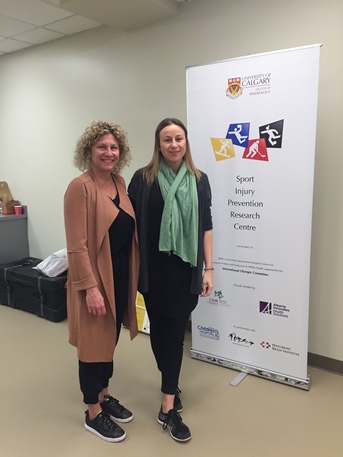
4 December 2017
Society Member Kate Evans Reflects on Her Bruce Hobbs Travelling Scholarship Trip to Calgary
[vc_row][vc_column][vc_column_text]
Society Member Kate Evans, Sports Therapy Programme Director and Senior Lecturer at the University of Wales Trinity Saint David, was the 2017 winner of The Society of Sports Therapists’ Bruce Hobbs Travelling Scholarship to Calgary in Canada. Kate’s winning application afforded her the opportunity to study a Continuing Professional Development course in ‘Prolonged Sports Related Concussion’ with Associate Professor, Dr Kathryn Schneider at the University of Calgary.
Kate, who is also Sports Therapist to Newport Gwent Dragons, takes up the story:
‘I had met Kathryn at an in-service training event organised by the Welsh Rugby Union (WRU) and the timing of it could not have been better; I had just supported two professional rugby players in their unsuccessful rehabilitation from a Prolonged Sports Related Concussion (PSRC) and subsequent retirement, and unfortunately, was on my way to the same outcome with a third player. That was until Kathryn’s one-day workshop revolutionised the way I approached the rehabilitation of players with PSRC symptoms. The one-day training course allowed me to rehabilitate the third player to return to full sports participation and competition. I was well aware that the one-day course was just the tip of the iceberg and whilst I was trying my best to apply my newly acquired skills, I was desperate to learn more by attending Kathryn’s CPD course in Calgary.
‘Whilst the majority of Sports Related Concussions resolve in less than 2 weeks for adults and 4 weeks for under 18s, the number of PSRC is becoming more prevalent. For sports related concussions, headache and dizziness are the most commonly reported symptoms. However, Dr Schneider’s research indicates that 85% of patients with cervical pain and vestibular signs, will have a prolonged recovery. These symptoms are often difficult to articulate with the athlete simply reporting they ‘don’t feel right’ or ‘something isn’t right’. This becomes frustrating for both the athlete and the medical team as the cause of the symptoms is not clear and treatment therefore becomes very difficult. Athletes are normally referred for a neurological consultation and prescribed a prolonged period of rest, which does not alleviate these feelings and symptoms. A prolonged period of rest away from the camaraderie of the team sports environment can subsequently lead to feelings of isolation and in some cases, psychological factors such as depression can further compound symptoms.
‘As soon as I knew I had won the award I made arrangements with Kathryn to attend her course. I was lucky enough to spend some time with Kathryn at the IOC Injury and Illness Prevention Course in Monaco in March and we agreed to meet again in Calgary for her course.
‘The course and trip to Calgary exceeded all my expectations. I acquired new techniques and approaches and was lucky enough to see Kathryn’s lab and its high specification equipment and meet her PhD students. To say the course is intense would be an understatement. I arrived well read in the field of concussion rehabilitation – but even so, it was overwhelming and the amount of new information was vast. Kathryn discussed at length the new SCAT5 protocols, the consensus meeting and subsequent systematic literature reviews that informed the new protocols. Whilst Kathryn’s laboratory facilities were impressive, I felt there was much to be gained from developing a simple (and low tech!) assessment strategy to help diagnose the potential root cause of the PSRC symptoms.
‘With this in mind, I have subsequently developed a short course in PSRC, which I hope to trial with some peers from the Society. It covers:
Incidence and predisposing factors for PSCR,
A detailed assessment of PSRC including Vestibular and Oculomotor assessment strategies,
Red flags and criteria for onward referral
How to develop a framework for rehabilitation of vestibular and Oculomotor dysfunction
Case Study examples
‘I have successfully used this information to help a further 5 professional rugby players return to sport following PSCR and I feel that this knowledge – given to other Graduate Sports Therapists will assist other athletes suffering with the vague, hard to describe symptoms associated with PSCR. In the long term, my hope is to have this specific field added to The Society of Sports Therapists’ competencies, so that all universities, and therefore graduates are competent in the assessment, treatment and rehabilitation of PSRC, as I feel strongly that this area is currently heavily underserviced. Our role is to work with all areas of illness and injury in the sport and exercise environment – and none are more topical than Sports Related Concussion.
‘Thank you all for the opportunity to deepen my understanding of this area. Without the support of the Society of Sports Therapists this would not have been possible’.
Professor Graham N Smith, Chairman of The Society of Sports Therapists said:
`The application for this trip was one of those considered by the selection panel for the Bruce Hobbs Travelling Scholarship and stood out not only for the quality of the application but because this is such a topical and important subject area. Kate`s undoubted experience in professional rugby and as an academic, also meant that not only would The Society of Sports Therapists get value from the knowledge she would gain from such a trip, but the players and students with whom she comes into contact, would do too.
The more we as therapists understand about this topic area then the more comprehensive and relevant the care we provide can be.
[/vc_column_text][/vc_column][/vc_row]
Continue reading 
13 November 2017
New Collaboration with York University, Toronto Provides a Memorable Experience for Laura Clint
[vc_row][vc_column][vc_column_text]University of Hertfordshire Graduate Laura Clint was the 2017 winner of the inaugural Travelling Scholarship to York University, Toronto. Laura was based at the Gorman Shore Athletic Therapy Clinic, a teaching clinic for students on York’s Athletic Therapy Certificate Programme. Loriann Hynes, Assistant Professor at York University, her husband Chris and two daughters Taylor and Kenzie hosted Laura’s stay. Laura had dropped us a line to let us know how the first part of her trip was going back in September and if you missed it, you can find it here.
Laura is now back from Canada. We caught up with her and chatted to her about her truly memorable trip which clearly just got better and better.[/vc_column_text][vc_column_text]
You arrived in time for the start of Football Camp. How did it go? Was there a typical day? What were your main roles?
Camp was very full on but I really enjoyed it! A typical day would involve going into the clinic mid- morning and treating the players. After this it would be lunch, which normally resulted in a trip to Tim Hortons. We would then head over to the stadium and prepare for practice in the evening. This would involve making sure we had enough tape stocked and first aid supplies etc. Taping normally lasted an hour and practice would start around 4 and go till about 8. During practice we would split up and cover different positional groups, supplying water and dealing with any injuries that occurred. After practice, we made sure the ice baths were ready and would assess any injuries that had occurred during the session.
Supporting the York University teams in pre-season training and match preparation was a fantastic opportunity at the start of your Sports Therapy journey. What did you learn and was there something that seemed to be easier in theory than in practice?
I learnt a lot! The biggest learning curve was the high demand for taping, sometimes in a relatively short space of time. I also got used to the fast pace of game days and being aware of the players on the field but also the constant interchange and monitoring players as they came on and off.
So how was your taping?
I think my taping definitely improved throughout my time at York. It took me a bit of time to get used to the different types and styles of taping they used, but I got the hang of it in the end and certainly got a lot of practise with the football players
What types of injuries did you see in the main?
During camp there were a few dislocations and once games started there was a variety of different ankle, upper body and head injuries.
You did some baseline testing with the football team for the Concussion Research Project with York University and UNC Chapel Hill. Can you tell us about the project and what it involved?
My main involvement with the project was helping out with the baseline testing of all the football and hockey players. This involved the players coming into the clinic and going through a series of tests including, memory, balance and eye tests. Recording the baseline measurements accurately was obviously an important part of the study as these would be needed for comparison should a concussion occur. By the end of the baseline testing, I was very confident with the whole testing procedure and will definitely implement it with teams I work with in the future.
How did you find it working with the student Athletic Therapists?
I really enjoyed having the opportunity to work with the students at York. I found it interesting learning how their course worked and being able to compare it to the UK. A big element for Athletic Therapy in Canada is placements right from the outset; this is the best way to gain experience and confidence in a variety of areas and sports. I was able to exchange ideas with the students, I learnt from them and hopefully I was able to help them out too.
[/vc_column_text][vc_column_text]
What was the best piece of advice you received while working with the staff within the Gorman Shore Athletic Therapy Clinic?
Believe in yourself and be confident with what you are doing.
You had a flying visit to Canada Ballet – How was it?
I really enjoyed my morning at the ballet, as having mainly had experience in contact sports, it was a completely new experience for me. The ballet dancers were very in tune with their bodies and were very specific with their requests for treatment. Testing their range of motion was very different to contact athletes. I was also lucky enough to watch one of their rehearsals which was amazing.
You were very busy last time we spoke to you and just had enough time to go see a Canadian Football League game and a visit to Niagara falls. Were you able to see any other sights since then?
After the trip to the ballet I got some time to explore Toronto, I went to Ripleys Aquarium and the CN tower. It was great to see the city from a different perspective.
Loriann also took me to a Toronto Blue Jays game, this was a definite highlight of my trip! The therapists for the Blue Jays gave us field passes to watch the batting practice beforehand and I was able to have a chat to them. I was particularly interested in how they manage the players through a very hectic schedule. I was very grateful when George gave me an official ball and then I managed to catch a second one. A particular highlight was managing to sneak into the dugout for a quick photo! The Rogers Centre is an awesome stadium so overall it was a really great evening.
On a day off Loriann took me to explore Oakville where they lived. Down by the water was beautiful and a nice place to relax. This was followed by a shopping trip that resulted in me having to buy a second suitcase at the airport. I finished my trip off by going to a local concert with Chris and Loriann which was a really great way to end an amazing trip.
How do you feel this experience has complemented your degree experience?
It has vastly improved my confidence as I was able to put into practice what I learned from my degree. It was very interesting to see the contrast but also the similarities in the courses and learn from each other. University sport in Canada is at a much higher level compared to the UK, this again benefited me as it was like working in a professional set up.
What do you miss the most now that you’re back from Canada?
I miss being part of the team of therapists and getting to go practice everyday.
What are your plans for the future?
At the moment I am doing some part time work with football and rugby teams. I would love to go back to Canada in the near future too!
What advice would you give to current 3rd year students about applying for the scholarship?
Definitely go for it, it’s an experience I will never forget and has helped me develop as a therapist. It gave me the opportunity to meet people that I know I will stay in contact with for a long time. An opportunity to experience new sports, places and broaden your mind as a Sports Therapist is not one to be missed.
Quick questions
Best moment – Batting practice at Blue Jays and sneaking into the dugout
Best food – That’s a hard one, I really liked Poutine… but Chris also made me a very good T bone steak.
Favourite Canadian expression – “eh?”
Three words to describe your trip – An unforgettable experience
Favourite sightseeing event – Niagara Falls
A sport you would like to work with again – I really enjoyed working with the football team, I would also like to get the opportunity to work with Ice hockey.
Before we finish can I just thank a few people ………..
Firstly thank you to Professor Graham Smith and the Society for offering me the opportunity to go to Canada.
Tracy, James, and Jo at the Gorman Shore Clinic – thank you for welcoming me into the clinic and for always being happy to help out or answer any questions I had. Also thank you to the football players and coaches for letting me be part of the team, I loved the opportunity to help you out and experience the football programme.
Val, Elizabeth, Maks, Billy, Angela and Gianluca – thank you for making my experience even better, getting each other through the long days in camp. I hope I was able to teach you guys a bit about Sports Therapy and I definitely took a lot away from you. I will miss our daily Tim Horton Trips.
Britt, you were just the best mentor. I will never forget the help and support you provided me throughout my stay. I know I will be a much better therapist as a result of your guidance.
Finally a massive thank you to Loriann, Chris, Taylor and Kenzie for welcoming me into their house and making me feel at home straight away. They went above and beyond to help me out and make sure I had the best experience possible. An extra thank you to Loriann for the amazing support you provided me. I will be back to visit soon!!
Professor Graham Smith, Chairman of the Society of Sports Therapists also added his thanks:
“This was the first time that we have collaborated with York University and we have to thank all of the staff and students who were involved in giving Laura the amazing experience that she seems to have had. The Society always feels privileged to be able to offer such opportunities to its new Graduate Members and as such, I would personally like to thank everyone concerned for making it happen. Laura was an outstanding ambassador for The Society and we are not only proud of her achievements but pleased that she has had an outstanding experience.”
[/vc_column_text][/vc_column][/vc_row]
Continue reading 
10 November 2017
Masters Sports Therapy Degree Provides Career Stepping Stone for Julie Anne Lacroix
[vc_row][vc_column][vc_column_text]
Julie Anne Lacroix graduated from the University of Gloucestershire with an MSc in Sports Therapy in November last year, previously earning a BSc in Kinesiology at the University of Montreal in 2012. She has since settled in the UK with her partner and currently balances her Sports Therapy skills between two very different sports; ice hockey and women’s football. After graduating in 2016, Julie became Head Sports Therapist for the Oxford City Stars, a UK based National Ice Hockey League (NIHL) team which currently plays in League 2, and she is also now working part-time with Aston Villa Ladies FC.
We spoke to Julie about her experiences in Canada and what motivated her to work towards an MSc at the University of Gloucester, and talked about her work in two different sporting arenas.
After graduating from the University of Montreal, Julie went on to work in a sports injury clinic in Montreal. She said:
‘I acted as a strength and conditioning coach, working with young and older athletes, or people coming back from injuries and getting back to work or to their sport. I was working alongside Athletic Therapists and was inspired to learn how to treat injuries in the same way. I loved that I could help injured people with exercises and movements, but I wished I could manually assess and treat them in order to help them even more.
‘Before deciding to take my education further, I went to teach Alpine Skiing full time for two years in Whistler, Canada. Getting away and doing something I am truly passionate about helped me decide what to do next. That’s when I came to the UK, the move also motivated by my British partner, to do the demanding MSc Sports Therapy programme at the University of Gloucestershire.’
Once Julie had graduated, and with the help of one of her mentors, she began working as Head Sports Therapist for the Oxford City Stars ice hockey team. She is still in the same role today and her duties are varied:
‘I take care of the health and safety of the players, making sure they are fit to play, and I attend all of the games and training sessions in case any traumatic injuries occur. I design and supervise their rehabilitation plans when necessary and try to influence their fitness through warmup protocols, as well as creating exercises programmes for them to do outside of the ice rink.
‘It is a very interesting environment to work in as the players all have different jobs outside of hockey, so I end up dealing with many issues that may not come from playing the sport. There are a variety of age groups within the squad, from 17 to over 35 years old.
‘Being Canadian, I have always loved hockey, and I feel lucky to be able to work within this sport here in the UK.’
Julie is also involved with the England National Team Programme (ENTP- a pathway development programme for younger players) for hockey, mainly overseeing the U14 squad. After the programme has ended, the athletes are able to try out for the GB U16 squad. Julie said:
‘It’s a good opportunity for the athletes from each age group to be skating and training with the best players in the country every three to four months, as well as being exposed to good training habits like warm-ups and cool-downs, fitness testing and strength and conditioning programmes. We hope to influence every ice hockey club in the UK by sending the players back to their own rinks with good habits.
‘Last year we went to Nymburk, in Czech Republic, for the selected players to play against European level teams, in order to learn and grow into better players. It was great to be part of such a fun trip.’
Julie’s skillset extends beyond the ice rink, however, as she has shown through her work with the Aston Villa Ladies FC Medical Team. Her role with the club is focused mainly on the Development Team and is part-time, which allows her to work with both the ice hockey and football teams, along with any other Sports Therapy opportunities she finds. Julie said:
‘I applied for the role and was thrilled to be invited to join the medical staff in this growing environment. So far, I’ve had the chance to work with many teams in different sports, but never with a women’s team, which I find particularly interesting.
‘It is also an exciting opportunity to work with this big-name club at a semi-professional level. I always find myself learning a lot and I hope this will help me to be a better practitioner in the future.
‘It was really exciting to go to the Manchester City FC training ground with the Development Team for a pre-season game and to see the extraordinary facilities there. Now the season is just starting and the Development Team is doing well. We try to get the players to their best fitness level so they can work towards playing in the First Team.
I’ve already helped two injured players return to play this season and to see them beaming as they went on the pitch was my best moment so far.’
Julie has a word of advice for Graduate Sports Therapists, whether they are looking to enter the world of professional football like her, or a different sporting environment entirely:
‘For any new Graduate Sports Therapist, I would say to never give up and apply for everything. Grab any experiences you can get your hands on, even if it involves some voluntary work, as they will lead you to be a better Sports Therapist every day. It’s in those small opportunities that you might find yourself learning the most. But most importantly, trust yourself as a Sport Therapist, because we really have the best job in the industry.’
[/vc_column_text][/vc_column][/vc_row]
Continue reading 
13 October 2017
International Placement Experience for Hartpury College Students
[vc_row][vc_column][vc_column_text]
International travel can often be part of a sports therapist’s role and Hartpury College 3rd year Sports Therapy students Sophie Kalpin, Hazel Fowmes and Kirsten Wing have enjoyed some great early experience, undertaking their placements with teams across the globe.
For Senior Lecturer Hollie Bailey, placements are an integral part of the programme. She said:
“We think it is important to encourage and support our students to gain as much experience in different sports and cultures,” and Lecturer and year tutor Sarah Sandford added: “It has been refreshing to see the change in the students from spending an extended period of time on placement and how they have developed as therapists”.
Here’s just a little taste of where and how the students spent their time
Sophie Kalpin enjoys life with the Eastern Illinois Panthers Football Team – (Eastern Illinois University) USA
“I was lucky enough to be offered a month long placement by Hartpury College with the Eastern Illinois Panthers in the USA. It was amazing to be working with an American football team. I was able to get involved with managing various injuries, developing rehab programmes, treatments and training programmes. I was able to work both pitch side and in a clinical setting. It seemed that in the USA they have a strong focus on using electrotherapy compared to the UK.
A highlight for me was working pitch side for their first game of the season, which they won! Being able to do my placement in another county and with a different sport has developed my sports therapy skills and knowledge massively. In addition, being able to do my placement abroad with a sport that I was not familiar with allowed me to apply the knowledge I had already learned and the skills I had developed in a new setting”.
Competition Experience for Hazel Fowmes in Sweden
‘I completed my placement with Team Bermuda, part of Bermuda Island Games Association when they competed in Gotland, Sweden, in the NatWest Island Games over the summer. I loved the whole experience of the games! Everyone was so friendly and it was nice to feel part of the team and be a part of all their achievements. For me it was good to experience being courtside during the games as well as in clinic. I spent most of my time with the volleyball team, which was a different sport that I have not really watched before.
It was interesting to see what planning is involved with travelling with a team aboard, and the additional responsibilities therapists have. It was an amazing experience; I encourage any up and coming Sports Therapists to go out of their way to experience placements in a different country. Well worth it!
Kirsten Wing Experiences Real Team Work with Cell C Sharks in South Africa
I was fortunate enough this summer to go to Kings Park on the Eastern Coast of South Africa, which plays host to the Cell C Sharks. I have spent two placement weeks with the medical team. I worked within a dynamic team of professionals from strength and conditioners massage therapists, biokineticists, physiotherapists and a sports doctor where I realised just how dynamic and well-versed therapists need to be in an interactive and cohesive medical team. I found the work of the biokineticists in particular, interesting and challenging, as the profession isn’t as common in the U.K. With the permission of Dr. Alan Kourie, Deane my supervisor allowed me to take part in the ‘complete injury rehab’ process where I was allowed to move with a high profile player from physiotherapy sessions, to clearance by the Doctor, out into the gym with the conditioners and finally, out to the field with the biokineticists and the coaches.
Through this, I witnessed how successful “keeping it simple and correct” can be: too often, the basic fundamental skills and approaches are overshadowed by new modalities and techniques. The vibrant and approachable practitioners I met in South Africa certainly have had a profound effect on my approach to successfully simplifying the approach to injury.
[/vc_column_text][/vc_column][/vc_row]
Continue reading 
12 October 2017
British Triathlon Provides Rich Source of Experience for Sam Barry-Wilson
[vc_row][vc_column][vc_column_text]
University of Gloucestershire Academic Subject Leader for Sport and Exercise Sam Barry-Wilson, talks in this article about how a chance conversation led to working with British Triathlon. It is a great example to anyone starting out on a career in Sports Therapy as to how things can develop, and the opportunities that can arise. For Society member Sam, her work in triathlon has provided her with great material for further study and also opened up some great experiential opportunities for her students.
Your work with British Triathlon goes back 10 years or even more –how did you first get involved?
In the very first sports injury clinic I worked in, I treated a patient who was involved in British Triathlon. As our conversation grew, he mentioned that championship events ran yearly and to various destinations and that my services as a sports therapist would be useful. I got in touch with British Triathlon and the rest is history. I have travelled across the globe with them to places I would never have dreamt of visiting. Often the championships are held in towns and cities that people are less familiar with. Since 2006 I have travelled with British Triathlon to one or two events a year; European events and World Championships. This opportunity has taken me as close to home as Edinburgh and as far from home as Australia and almost everywhere in between. I have been truly blessed with the experiences I have had.
Tell us a little about your latest trip to the Tri World Championships in Rotterdam
This event was the grand final in the ITU World Championship Series with races for the para-tri team, elite, age groupers and juniors. Both Sprint races and standard Olympic distance races were taking place that required pre-qualification (that usually happens somewhere on British turf. The British age-group team (which was the group I predominantly worked with at this event) comprised approximately 700 athletes. The British team always has a large presence at events held in Europe. Rotterdam itself was beautiful and although it rained most of the time, the sunshine came out on race day for the Age groupers.
What was your main role and how long were you there for?
My role as Team Therapist is to offer pre-race and post- race therapy. For the most part this is basic race prep and soft tissue work, but many come with injuries that have been sustained in the lead up to the worlds and sometimes longer. Of course, the work is pretty reactive and I can only do what I can in such a short time frame. It’s imperative that I don’t overload the athletes or aggravate; this could have negative implications on the race. I do whatever I can to make them move better, feel less pain or be more confident that that “niggle” they have felt in training will be okay.
Occasionally I get athletes who go out for a bike race and fall off, or feel something on a training run, so I do what I can in the time before the race. I was flown out on Tuesday night and booked in for treatments from Wednesday to Sunday. The days are pretty full on, as you can imagine with such a large team. In total I saw about 35-40 athletes . Luckily for me there was another team therapist with me who I have worked with a number of times. There is a pool of about 7 or 8 therapists who are used for these major events.
What were the main injuries you had to deal with?
This year the main issues were Hamstrings – mid belly and insertional problems, broken toes, Post shoulder surgery, Hip impingements, Lower back problems, – you name it- although, I didn’t have many knee based complaints this time. There is certainly a lot of work to mobilise feet and ankles.
In terms of the three disciplines which do you feel causes the most problems for the competitors?
I would say that the majority of pain is brought about by either a) Coming off the bike by crashing or b) Overload. Triathletes often train too much and see themselves creeping into non-functional over reaching. I would say that overload causes many of the running based issues for triathletes but the great thing about triathlon is that there is always another discipline you can be working on. I see very few problems related to swimming other than the odd issue caused usually by poor Range of Movement (ROM) or strength.
Triathlon is a gruelling event – did you find yourself dealing with the mental side of eventing as well as the physical side?
Every athlete is different. I am acutely aware that I have the ability to affect someone’s current mind state with regard to the race. Pretty quickly you get a feel for how that person is feeling about the task ahead and their approach to it. I find myself saying “ Yes I’ve heard it’s a technical bike course, but no more difficult than X race” or “ Yes it might rain, but everyone is facing the same conditions” Mostly I find that it settles those who are nervous.
How have things changed in triathlon in recent years? Has the medical provision changed?
I don’t think the medical provision has changed drastically, but certainly there are now more dedicated teams. For example in the early 2000’s I was assigned to treat Elite only, in another year I was responsible for both elites and age groups. The para – tri team have their own therapist, although I did treat Andy Lewis this year, as do the age groupers and elite. Andy won World and European titles this year and won gold in Rio.
Triathlon has become immensely popular in recent times – why do you think this is so?
I think the 2012 Olympics played a huge role in this growth. Since that time there has been mass growth in sports, coupled with some very successful events for British athletes. Britain has a very strong group of competitors on the circuit with very promising juniors who we will start to see much more of. The Brownlee brothers are everywhere from GSK Human Performance Labs to Yorkshire tea adverts – these guys have been an inspiration to the next generation of world class triathletes and I think we can expect great things.
We understand you are studying for a PhD investigating the stress and immune response to exercise and recovery intervention. Have you worked with triathletes as part of your study?
The first investigation was undertaken at the World Championships in London 2013. 13 age group athletes took part in this study and did a great job of providing me with saliva samples in the lead up to, before and after the race. The idea of the study was to investigate the athlete’s response to a field based event, which is challenging, due to all of the external factors that could affect the athlete. I measured Cortisol a stress marker and IgA an immune function marker. The results of this work are yet to be presented or published…so I will save the surprise. I took 10 Sports Therapy students to volunteer at this event; some helped with data collection and others provided therapy to athletes from all over the world.
As Academic Subject Lead for Sport & Exercise at the University of Gloucestershire what advice would you give to anyone thinking about a career in Sports Therapy?
I do this job because I love it! Helping people to develop/achieve/perform/compete is a pleasure and I was overwhelmed when Andy Lewis MBE tweeted me after Rotterdam to say thank you for treating him. He was able to train the next day which would have been important to him – that’s what it is all about. My advice would be take every opportunity offered to you. Make links, make contacts, knock on doors and show them your value. Everything I am proud of has come out of an opportunity or an experience. They won’t know how good you are until you show them.
[/vc_column_text][/vc_column][/vc_row]
Continue reading 
4 October 2017
UCB Sports Performance and Rehabilitation Student Conference
[vc_row][vc_column][vc_column_text]University College Birmingham is hosting a Sports Performance and Rehabilitation Student Conference on Friday 27th October, 9-4.30pm.
Aimed at 2nd and 3rd year students and recent graduates, topics will include monitoring training and competition loads, minimising and reversing disuse-induced muscle atrophy, reducing knee injuries in elite female soccer and also included will be some of the most pressing issues faced by industry professionals today.
The conference is designed to provide comprehensive and invaluable insight into the issues surrounding sports performance and rehabilitation.
Joseph Matthews, event organiser and UCB Sports Therapy lecturer, said:
“We are privileged to have some of the UK’s most prominent sports scientists and therapists coming along to share their knowledge and experience. If you have a particular interest in the preparation of athletes or are an aspiring student in this field, you will be spoilt for choice in terms of the topics set to be covered over the day.”
Tickets, costing £20 for external delegates, £10 for UCB students and alumni, are now on sale for the full-day event at UCB’s McIntyre House in Holland Street, Birmingham, where speakers are set to include the renowned Professor Craig Twist, who works with the Rugby Football League and England Touch Association.
For the full itinerary and to book tickets, visit the Eventbrite page. Capacity is for 180 delegates, so book early to avoid disappointment.
EVENT: UCB Sports Performance and Rehabilitation Student Conference
DATE: Friday, October 27th
TIME: 9am – 4:30pm
VENUE: Lecture Theatre, McIntyre House, Holland Street, Birmingham, B3 1PW
For details of speakers please click link below
For further information, contact UCB Sports Therapy lecturer Joseph Matthews at J.Matthews2@ucb.ac.uk or on 0121 604 1000 (extension 2395).[/vc_column_text][/vc_column][/vc_row]
Continue reading 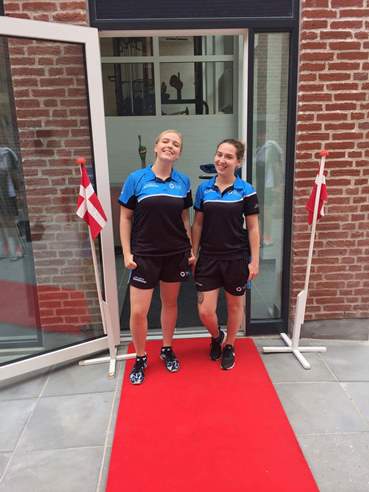
21 September 2017
England Handball Provides Great Opportunity for Two Bucks New University Students
[vc_row][vc_column][vc_column_text]
Bucks New University Sports Therapy Students Marilie Appel and Michaela Weedon recently undertook a groundbreaking trip to Denmark with athletes and staff from England Handball. Sports Therapy Course Leader Kevin Campbell- Karn said : ‘This was a great opportunity for Marilie and Michaela and they both did extremely well. Their roles were essentially to provide pitch-side First Aid, taping, strapping and sports massage. These were all areas which they had successfully studied as part of their course, and for which they were insured for the trip.’
Marilie takes up the story:
‘800 miles away from home, thrilled and yet nervous with anticipation we arrived at Idrætshøjskolen in Aarhus, Denmark. Travelling with 37 athletes and staff of England Handball, Michaela and I had been given the opportunity to provide first aid and treatment cover for the week as part of the students Advanced Apprenticeship for Sporting Excellence (AASE) training camp*.
‘Our trip was off to a rocky start as we were informed that our first aid kit bag had accidentally been sent back to London, leaving us with no equipment. However, we were soon able to make a trip to a local sports shop and invested in basic strapping and first aid equipment to help us get through the week. Fortunately for us, our accommodation provided us with a therapy room allowing us to have somewhere to work with the athletes each day.
‘We had an early start each morning with breakfast at 7:00 followed by treating players before training which was usually at 9:00. Training sessions lasted around two hours, which tended to be one morning session and one evening session after dinner. We would continue to work with the players before and after training sessions, sometimes as late as 22:30 in the evening.
‘It was interesting to watch the players training especially as I had little knowledge of the sport prior to this trip. The female team invited us to join in on a training session which allowed us to understand why some of the more sport specific injuries from handball occur, such as tack blisters and rotator cuff overuse. Getting involved was also a great way to break the ice with some of players.
‘During the week we also travelled to another Danish school where the athletes trained with Danish students and played friendly matches against them. This allowed us to practise pitch side first aid. During this experience we saw minor injuries mostly but also had one incident in particular occur which was the worst injury of the game and week. It involved a high-speed impact between two players that resulted in a severe contusion to the quadriceps. The player was unable to take part in training for the remainder of the week.
‘We also had the chance to explore Aarhus city for a few hours one afternoon with the athletes; this again was another great opportunity to keep building our rapport with them and to see a new city.
‘The day before we left Denmark was my birthday and the whole team had got together with the help of Michaela and surprised me with a signed card, birthday cake and balloons, making it a very special day for me. We made close friends with a lot of the athletes on the camp and gained excellent contacts for the future.’
‘Amongst all the things I learnt from this trip, I think the most important thing that I can take from this is to not be afraid to put yourself out there for opportunities. This was the first time that we were looking after a whole team and I was worried that I wouldn’t know what to do, but our training kicked in and we supported each other where we had weaknesses and this allowed our strengths to more easily be put to focused use. Secondly, we realised how important kit organisation is to being a successful and professional therapist. Firstly having enough kit, but also knowing what’s in your kit bag and where it is for quick and easy access. Lastly, I learnt that athletes who train often have a good understanding of their own long term injuries so it is essential talk to them and understand their needs and to work from there.
‘My advice to future students looking for placements would be to take yourself out of your comfort zone because what you learn out of the experience is so much more rewarding than the brief period of time where you might feel nervous.
‘Finally I would just like to give a special thanks to England Handball for funding all our expenses for this trip and to Kevin Campbell-Karn, Neal Reynolds and Déarbhla Gallagher at Buckinghamshire New University for organising the opportunity for us’.
https://bucks.ac.uk/courses/undergraduate/health-and-social-sciences/sports-therapy-ft-1718
*Advanced Apprenticeship for Sporting Excellence (AASE):
‘SkillsActive, National Governing Bodies (NGBs) of sport and industry experts developed the programme in 2004 to ensure top young athletes seeking to perform at the highest level receive the support and training they need to succeed in elite sport. The programme has also been designed so that if an athlete falls short of their ultimate goal, they have the skills, knowledge and qualifications to pursue a secondary of supplementary career.’
Taken from here[/vc_column_text][/vc_column][/vc_row]
Continue reading 
18 September 2017
University of Windsor Proving a Big Hit with Zoe Hughes-Jones
[vc_row][vc_column][vc_column_text]University of Chichester Graduate Zoe Hughes-Jones was this year’s winner of the University of Windsor Travelling Scholarship. Athletic Therapist Kathy Harvie had travelled to England in July to be part of the interview process, and together with her husband John were both at -Windsor Airport to meet their 9th Society of Sports Therapists’ Graduate Winner.
It’s clearly been a hectic start for Zoe, but we had a brief chat with her to see how things were going.
You had a whirlwind lead – up to your trip, how did you feel when you finally set foot on Canadian soil?
It felt so good to finally arrive in Canada after a long few days of travelling (I was in Bali for 10 days beforehand). Kathy and John were standing at the Arrivals lounge when I arrived and it was easy to spot them as Windsor has a very small airport! We went out for dinner that evening to try and keep me awake for a bit longer, so I could adapt to the different time zones.
Did you have a few days to get used to the new surroundings?
After some much needed sleep, I went into the University at around 2pm to meet everyone I was going to be working with and it has been all go since that day!
What were your first impressions of the University + Clinic? What struck you as different from your own university?
After having researched the university before coming to Canada, I already had an idea of what it would look like. However, it surpassed all of my expectations and is a true representation of a Canadian University. The clinic is perfect for the athletes and I love the fact they have a separate room just for taping; something you don’t usually see back in the UK!
What have been your main activities over the first couple of weeks?
I have been based with the Football team, as it was their pre-season summer camp. They had double practices most days and I was in the clinic taping from 6:30am so they could be out on the field at 8am sharp. Players soon started coming in with injuries so I spent time with them in between being out on the field covering the practices.
How has life been in the clinic with Dave and team?
Everyone has been so welcoming at the University; including Dave, Natalie and Adam in the clinic and all the coaches and supporting staff. I am learning new things every day and am always being challenged. Dave always brings in Tim Bits and coffees on game day which is just what we need to get through the day.
Have you watched any matches or been pitchside?
I have been pitch-side for all of the Football games and practices which has been a great experience so far! There is always something to be doing and the players are slowly teaching me the rules of the game as it’s a lot more complicated than football back in the UK! I have also been pitch-side for one of the men’s basketball games; I didn’t realise how quick the game is until now. With my love for football, I have also been watching their games when I have the opportunity.
Have you had any time for any socialising?
I have been able to get out and about a bit including visiting the casino, walking down by the Detroit river, experiencing a Canadian night out in the bars and Kathy has taken me to their shopping malls over here!
Have you had the seal of approval from Andy and Amos?
Andy and Amos (Kathy’s two dogs) are beautiful! They are always there to welcome me home after work by jumping up at the fence and barking like crazy. We also looked after John’s daughter’s dog (Murphy) for a week or so and he was just a puppy and he was also adorable!
And the Best bits so far?
I loved watching the first Football game with the players running out of the tunnel to a pre-mixed song and hearing everyone go mad for it.
I have honestly loved every minute of my experience so far and cannot wait to see what the rest of it has to offer.
We look forward to hearing more news from Zoe in due course.[/vc_column_text][/vc_column][/vc_row]
Continue reading 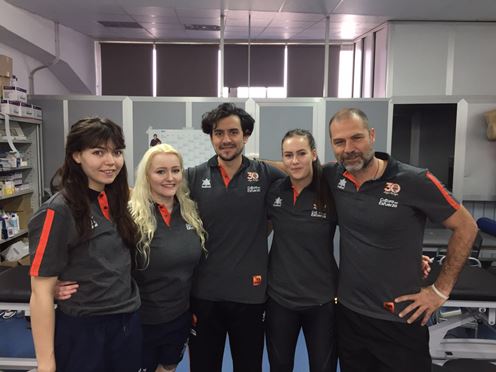
4 September 2017
University of Worcester Students Revel in Placement at Top Spanish Basketball Club
[vc_row][vc_column][vc_column_text]Sports Therapy students from the University of Worcester recently completed a placement at a Spanish basketball club, Valencia Basket, which plays in the Liga ACB and Euroleague. The placement gave the third year students, Charlotte Byde, Rebecca Gwilliam and Katie Cousins, valuable insight into working in the sport at an elite level.
Last year, Head Physiotherapist at Valencia Basket, Pablo Martínez, gave an inspiring talk to the Worcester Sports Therapy students, which motivated the students to want to visit the world class Club and complete a placement there. This was possible due to the partnership agreement between the University of Worcester, owner of the Worcester Wolves basketball side, and Valencia Basket, the current Spanish basketball champions.
Their experiences at the Club ranged from rehabilitation classes to training preparation, as well as a day in the clinic, a game day and a tour of the facilities. They were also given some tips on taping techniques, which were different to what they had seen in the UK.
The placement added to the students’ existing Sports Therapy knowledge, with therapists taking the time to teach new techniques to the students. Charlotte said:
‘The training preparation sessions allowed us to learn their techniques of taping and mobilisations. It was amazing to see how differently things were done at Valencia Basket. For example, taping at the ankle utilised tape we’d not seen before, applied in such an organised path that it was hard to recreate at first! The therapists were very patient with us, explaining everything fully to ensure we understood each point and allowed us to practise on each other and film their techniques.
‘The game day was incredible. With courtside seats we were able to watch the players we had helped treat in action. I wish to continue studying abroad in the future and would recommend it to everybody wanting to build upon their knowledge and broaden their experience within the Sports Therapy field.’
Katie added: ‘It provided a new and different insight into the world of Sports Therapy.’
Each of the students found the experience beneficial and thoroughly enjoyed their time at the Club. Rebecca said:
‘If ever any of us had this opportunity again we would take any chance we had to go back out there, spend some more time with the medical team and learn a lot more about the treatment techniques, styles and rehabilitation exercises.’
Dr Darren Cooper, Senior Lecturer in Sports Therapy at the University of Worcester, said:
‘It’s great that through this partnership we are able to offer our students the chance to do such unique work experience abroad at such a high profile club. Our students had a rare opportunity to see how professional teams operate behind the scenes and it is this kind of real-life experience that will help prepare them to enter the Sports Therapy industry and also give them greater insight if they wish to pursue a career in elite sport.'[/vc_column_text][/vc_column][/vc_row]
Continue reading